


Prototyping
By co-developing scalable data and policy solutions, the Data Innovation Lab facilitates tech discovery and supports partners strengthen their digital autonomy and position themselves in digital sovereignty debates while promoting an open, human-rights-aligned internet.
NegotiateCOP – Supporting Climate Negotiations
International negotiations, particularly within the framework of the United Nations, are complex and challenging, especially in times of geopolitical tension and a multipolar world order. This is particularly true for the negotiations on the Paris Agreement and the annual climate conferences, which have been held since the first UN climate meetings in the 1980s and the first COP in 1995. The aim of these conferences is to prevent or mitigate the impacts of the climate crisis by limiting global temperature rise, reducing greenhouse gas emissions, and implementing measures for climate change adaptation.

Prototype: AI Avatar – A trainer for diplomatic negotiation skills
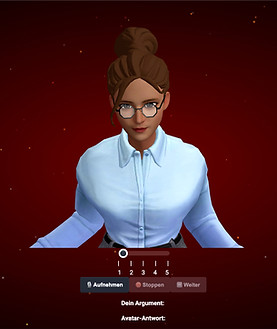
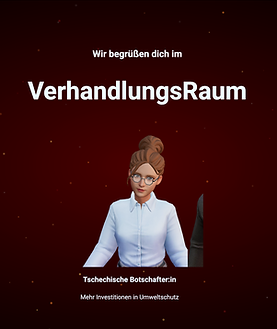
This innovative tool is designed to support diplomats or attachés in training or in developing and practicing their negotiation skills. Users have the option to select from a range of predefined opponents representing diverse roles and areas of expertise, such as a diplomat specializing in climate policy, a Big Tech entrepreneur, or an EU representative focused on tariffs. Each avatar articulates its perspective in alignment with its role and strategic interests. Users can respond by recording their own statements, to which the avatar replies according to its position. Beyond predefined scenarios/roles, this prototype also offers the option to create customized cases: users can upload documents that the system processes into a new position or avatar for dialogue and debate. By engaging with these structured yet dynamic interactions, trainees can practice their responses /strengthen their ability to respond to complex real-world scenarios.
TECHNICAL EXPLANATION
In this prototype version, the Negotiation Trainer combines a FastAPI backend with a React frontend to create an immersive practice environment. Uploaded PDFs are processed with PyMuPDF, while ffmpeg and whisper.cpp handle German speech-to-text transcription. GenAI formulates opening statements and dynamic responses, which are delivered through a ReadyPlayerMe avatar using the Web Speech API. With this integration of natural language processing, speech recognition, and lifelike avatars, the tool provides a realistic and adaptive negotiation experience.
VISION
Future development of the Negotiation Trainer will include improved features for the user experience, including a wider range of predefined scenario options, offer preparatory tools for discussions, provide real life examples, and speech-to-text transcriptions available in multiple languages. Consideration is also being made for features such as defining goals and red lines, integrating cultural sensitivity, and enabling rapid-fire exchanges, which will allow users to practice under more complex conditions.

Leveraging LLMS in enhancing multilateral negotiations
November 2023 - January 2024
This project, conducted in partnership with Omdena, leveraged cutting-edge Large Language Models (LLMs) and advanced techniques to address challenges faced by foreign policy experts in navigating complex negotiations. Specifically, we developed a Proof of Concept AI assistant to help policy officers summarize a large number of policy documents and make queries from these documents. Focusing on the UN's Global Digital Compact (GDC) negotiations as a test case, the project successfully illustrates the benefits of integrating AI tools into the workflows of policy officers. We are delivering a Proof of Concept (PoC) system suitable for beta testing, which is also a solid foundation for a widely deployable production system should further development work be pursued.